The short answer
Fasten a catio to the house with a pressure-treated 2x8 ledger lag-screwed into the wall framing every 16 in, never nailed and never into brick or stone veneer, with flashing over it. Keep it off any bedroom escape window, and ask the building department: attached catios are outside the small-structure permit exemption. Our 8x5 lean-to costs $1,053.83 in materials.
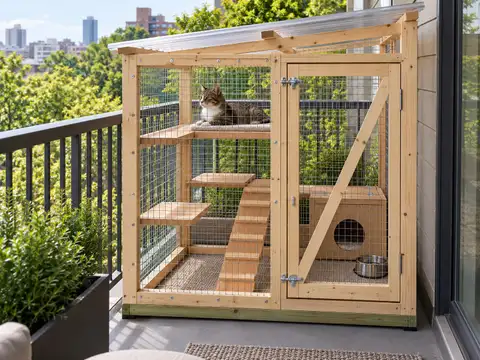
A catio attached to the house is a lean-to: three walls of mesh and a roof, with the house wall as the fourth side. Catios run from small window boxes to large enclosures and can stand on their own or be attached to the house or the garage, as Humane World for Animals1 puts it. Attaching one has two big advantages: the cats come out through a window or a cat door without you carrying them, and you save a wall of framing and mesh. It also asks two things of you: fasten it to the house framing properly, and keep it off the windows that must stay clear.
- 1Humane World for Animals (formerly the Humane Society of the United States) Catios: Safe Outdoor Enclosures for Happy, Healthy Cats (2026)
Lean-To or Window Box
There are two ways to build a catio on the house.
Lean-to catio
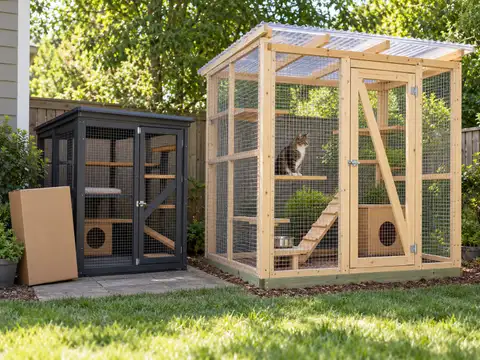
A lean-to is a walk-in or a hatch-access catio against the wall, with a roof that falls away from the house. Our 6x4 lean-to costs $903.75 in materials, the 8x5 $1,053.83 and the 12x6 $1,276.36. A freestanding catio of the same 6x4 size, with the same fit-out, is $910.88.
Window box catio
A window box hangs on the wall under a window and the cats step out through the open sash. It is the cheapest catio we draw, $433.05 for a 30 x 36 in window, and it needs no floor space at all. See the window box catio plan.
How to Fasten a Catio to the House
Nothing in the US building code is written for catios. The closest thing is the deck ledger rules in the International Residential Code2, so our plans follow them by analogy. A builder or your building department confirms the fastening for your wall.
A treated 2x8 ledger into the framing
The roof of a lean-to sits on a ledger: a pressure-treated 2x8, level, fastened through the siding and sheathing into the house framing, the studs or the rim joist. IRC2 2021 R507.9.1 sets 2x8 as the smallest ledger and requires pressure-treated or naturally durable wood with hot-dip galvanized or stainless fasteners. Our plans use 1/2 x 4 in hot-dip galvanized lag screws with washers, every 16 in along the ledger.
Never nails
R507.8 requires a deck fastened to the house to have positive anchorage, without toenails or nails in withdrawal. The same goes for a catio: lag screws or through-bolts, never nails. The side walls’ end studs are lag-screwed into the wall every 24 in as well. The purlins are then tied down to the side walls with hurricane ties at both ends, 6 of them on the 8x5.
Flash over the ledger
Water running down the wall must pass in front of the ledger, not behind it. R703.4 requires corrosion-resistant flashing where a deck or porch meets a wood-framed wall, and R507.2.4 sets its minimum thickness. Our plans add a galvanized Z-flashing tucked under the siding above the ledger, lapped 4 in at the joints.
Check before you build
Find the framing before you drill
Locate the studs or the rim joist behind the siding with a stud finder and confirm with a small pilot hole. A lag screw that only bites siding and sheathing holds almost nothing. Animal Welfare Victoria6 describes the same: wall plates fixed to brick with anchors, or to timber houses with coach bolts through the cladding into the frame.
- 2International Code Council Chapter 1 Scope and Administration, R105.2 Work exempt from permit (2021)
- 3International Code Council Chapter 3 Building Planning, R310 Emergency Escape and Rescue Openings (2021)
- 4International Code Council Chapter 5 Floors, R507 Exterior Decks (2021)
- 5International Code Council Chapter 7 Wall Covering; Chapter 5 Floors (2021)
- 6Animal Welfare Victoria (Agriculture Victoria, Australia) Building a cat enclosure attached to an existing structure (2026)
What Kind of Wall You Have
The designer asks what the wall is, because it changes what we draw.
Wood siding over framing
The straightforward case: the ledger goes over the siding into the framing, flashed on top. Our designer marks it “Read this” with the fastening notes.
Vinyl siding
Vinyl siding should not be clamped under a ledger. The usual fix is a mounting block or a cut-out so the ledger bears on the sheathing; we found no code text for this, so our designer marks vinyl amber and asks you to have it checked.
Brick or stone veneer
A ledger is never fastened to brick or stone veneer (IRC2 R507.9.1): the veneer is a skin, not structure. Our designer refuses a lean-to on veneer. The alternative is a freestanding catio set close to the wall, with the gap closed in mesh.
- 2International Code Council Chapter 1 Scope and Administration, R105.2 Work exempt from permit (2021)
- 3International Code Council Chapter 3 Building Planning, R310 Emergency Escape and Rescue Openings (2021)
- 4International Code Council Chapter 5 Floors, R507 Exterior Decks (2021)
- 5International Code Council Chapter 7 Wall Covering; Chapter 5 Floors (2021)
Windows: the Way In, and the One to Leave Alone
The cats’ way in
The cats reach an attached catio through a window or a cat door. A window you open whenever the cats go out is the simplest; a cat door fitted in a window panel or the wall lets them come and go. Humane World for Animals1 notes that with easy access back into the house, the litter box can stay indoors.
Never over a bedroom escape window
Every sleeping room must have an emergency escape and rescue opening to the yard (IRC2 2021 R310.1). Anything covering it, including screens and similar devices, must come off from inside without a key, tool or special knowledge (R310.4.4). A catio over that window blocks the way out in a fire. Our designer refuses a lean-to or a window box marked as covering a bedroom window; pick another window or wall.
A door to the outside, too
Even when the cats come in from the house, you need a door or a hatch from outside to clean and to reach a cat. Best Friends7 says so for window catios specifically, and every one of our attached designs has one.
- 1Humane World for Animals (formerly the Humane Society of the United States) Catios: Safe Outdoor Enclosures for Happy, Healthy Cats (2026)
- 2International Code Council Chapter 1 Scope and Administration, R105.2 Work exempt from permit (2021)
- 3International Code Council Chapter 3 Building Planning, R310 Emergency Escape and Rescue Openings (2021)
- 4International Code Council Chapter 5 Floors, R507 Exterior Decks (2021)
- 5International Code Council Chapter 7 Wall Covering; Chapter 5 Floors (2021)
- 7Best Friends Animal Society Outdoor Catio Ideas: What You Need to Know (2026)
Tunnels: Connecting a Catio Across the Yard
If the best spot is not against the house, a mesh tunnel connects a freestanding catio to a door or a window. PAWS (Lynnwood, WA) describes enclosed stairs and tunnels as a safe route between the house and the catio. Our tunnels are 18 x 18 in mesh frames; a 6 ft tunnel adds $116.91 to our 8x6 freestanding catio, and the catio cost calculator prices it for your layout.
Attached or Freestanding: What It Costs
Size for size, a lean-to usually costs less than a freestanding catio, because the house is one wall. Our designer’s totals for the same size, cats and shelves, without a litter nook in either, materials only, at the shelf prices we read in October 2026:
| Size | Lean-to on the house | Freestanding | Difference |
|---|---|---|---|
| 6x4 | $903.75 | $910.88 | $7.13 |
| 8x5 | $1,053.83 | $1,090.29 | $36.46 |
| 12x6 | $1,276.36 | $1,379.92 | $103.56 |
The saving is not only money. A lean-to takes less yard, keeps the cats close to the house, and lets them come and go on their own through a window or a cat door. The trade-off is the fastening to the house, the flashing, and the permit question below. The catio cost calculator prices both versions of any size.
Building a Lean-To Catio, Step by Step
The full build is in how to build a catio; these are the steps that differ when the catio is on the house.
1. Mark the ledger
Decide where the roof meets the wall, high enough for the walk-in door at the front after the roof falls 1-1/2 in per foot away from the house. Mark the ledger level, and find the studs or the rim joist behind it.
2. Fasten and flash the ledger
Lag-screw the pressure-treated 2x8 into the framing every 16 in with hot-dip galvanized lag screws and washers. Tuck the Z-flashing under the siding above it so water runs over the ledger, not behind it.
3. Stand the side walls against the house
Build the side walls flat, stand them, plumb them, and lag-screw their end studs into the wall framing every 24 in. Then the front wall with the door, screwed to the side walls at the corners.
4. Purlins from the ledger to the front
The purlins run across the side walls, the ledger carrying the back of the roof. Tie both ends of every purlin with a Simpson8 H2.5A.
5. Mesh, roof, door and shelves
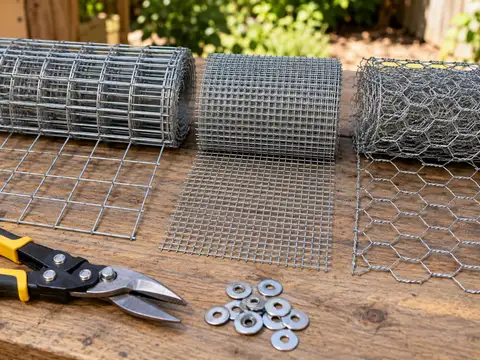
From here a lean-to is built like any catio: welded wire on the outside of the frame every 6 in, polycarbonate panels or mesh on the purlins, the door with stops on four sides, then the shelves. Close the mesh to the house wall along both side walls and under the ledger, where gaps hide.
- 8Simpson Strong-Tie (maker) Wood Construction Connectors catalog C-C-2026, H2.5A hurricane tie (2026)
Attaching Without Drilling
Searches for how to attach a catio to a house without drilling come up often. We do not recommend it for a lean-to: the ledger carries the roof, the wind load and the weight of cats climbing the mesh, and lag screws into the framing are what hold that. Anything clamped or stuck to siding is for a very light enclosure only. If you cannot drill, because you rent or the wall is not yours to change, the better answers are a freestanding catio with a tunnel to a window, or a lightweight window insert; the balcony catio guide covers the renter options in detail.
Clearances and Setbacks
Related searches also ask about catio clearance, meaning how far the catio must stand from a property line, a gas meter, a vent, an air conditioner or a dryer exhaust. We cannot give one number, because setbacks come from your local code and your utility. What to check before you draw the footprint: the distance to the property line, any meters or vents on the wall you plan to use, and the swing of the doors and windows on that wall. A lean-to that covers a dryer vent or a gas meter is the commonest thing that has to move.
Living With an Attached Catio
Is it better for a cat to be inside or outside?
People also ask whether a cat is better kept inside or outside. A catio is the middle answer, not a replacement for the home: Humane World for Animals1 and Best Friends7 describe it as outdoor time in an enclosure, with supervision and a way back indoors, and we write the designs on that basis. It is a welfare choice for you and your vet, not a number we can compute.
Can a cat live in a catio full time?
No. We found no welfare source that supports full-time living in an enclosure, and Best Friends7 advises against leaving a cat in an isolated enclosure in severe cold. A catio attached to the house makes the right pattern easy: the cat chooses when to go out and when to come in.
Predator-proofing
The best outdoor cat house for protecting a cat from predators is an enclosure with welded wire on every side, a roof, and fixings every 6 in, which is what the designs in this guide use. See best wire for a catio for the mesh and the apron against digging.
- 1Humane World for Animals (formerly the Humane Society of the United States) Catios: Safe Outdoor Enclosures for Happy, Healthy Cats (2026)
- 7Best Friends Animal Society Outdoor Catio Ideas: What You Need to Know (2026)
Choosing the Wall
Which side of the house
Pick a wall with a window or a door the cats can use, a stretch of wall clear of downspouts, vents and meters, and ground or patio that drains. Sun matters too: Animal Welfare Victoria6 asks for shelter from sun, wind and rain with access to sun, so a wall that gets morning or afternoon sun, with the solid roof for shade, gives the cats the choice.
The garage
A catio can be attached to the garage as well as the house, as Humane World for Animals1 notes. The fastening rules are the same: into the framing, through a treated ledger, flashed. A garage window or a cat door in the garage wall then becomes the way in, which only works if the cats can get from the house to the garage.
- 1Humane World for Animals (formerly the Humane Society of the United States) Catios: Safe Outdoor Enclosures for Happy, Healthy Cats (2026)
- 6Animal Welfare Victoria (Agriculture Victoria, Australia) Building a cat enclosure attached to an existing structure (2026)
Permits for an Attached Catio
The model code exempts one-story detached accessory structures up to 200 sq ft from a building permit (IRC2 2021 R105.2). A catio fastened to the house is not detached, so that exemption does not cover it. Ask your building department before you build, and, as Humane World for Animals1 advises, ask your landlord and your HOA too.
- 1Humane World for Animals (formerly the Humane Society of the United States) Catios: Safe Outdoor Enclosures for Happy, Healthy Cats (2026)
- 2International Code Council Chapter 1 Scope and Administration, R105.2 Work exempt from permit (2021)
- 3International Code Council Chapter 3 Building Planning, R310 Emergency Escape and Rescue Openings (2021)
- 4International Code Council Chapter 5 Floors, R507 Exterior Decks (2021)
- 5International Code Council Chapter 7 Wall Covering; Chapter 5 Floors (2021)
Next Steps
Open the catio designer, pick “attached to your house (lean-to)”, set the wall type and the size, and it draws the ledger, the lag screws and the flashing for you. For the rest of the build, read how to build a catio; for the mesh, the best wire for a catio.
Sources
Every number in this guide that does not come from our own catio designer was checked against these 9 documents, numbered in the order the text first cites them and read between Oct 10, 2026 and Oct 13, 2026. 9 are welfare bodies, codes, makers and stores.
- 1Humane World for Animals (formerly the Humane Society of the United States)Catios: Safe Outdoor Enclosures for Happy, Healthy Cats (2026)
- 2International Code CouncilChapter 1 Scope and Administration, R105.2 Work exempt from permit (2021)
- 3International Code CouncilChapter 3 Building Planning, R310 Emergency Escape and Rescue Openings (2021)
- 4International Code CouncilChapter 5 Floors, R507 Exterior Decks (2021)
- 5International Code CouncilChapter 7 Wall Covering; Chapter 5 Floors (2021)
- 6Animal Welfare Victoria (Agriculture Victoria, Australia)Building a cat enclosure attached to an existing structure (2026)
- 7Best Friends Animal SocietyOutdoor Catio Ideas: What You Need to Know (2026)
- 8Simpson Strong-Tie (maker)Wood Construction Connectors catalog C-C-2026, H2.5A hurricane tie (2026)
- 9PAWS, Lynnwood WAAll About Catios (2020)