The short answer
Use galvanized welded wire with openings of 2 in or less (we use 1 x 2 in at 16 gauge) or 1/2 in hardware cloth. Avoid chicken wire and plastic netting: predators tear them. Fix the mesh on the outside of the frame every 6 in with stainless screws and washers. On our 8x6 catio the welded wire costs $251.96.
The best wire for a catio is galvanized welded wire with openings of 2 in or less, or 1/2 in hardware cloth. That is what animal welfare authorities and catio builders converge on, and it is what our catio designer uses by default: 1 x 2 in welded wire at 16 gauge. This guide explains why, what to avoid, how to fix the catio mesh so no cat squeezes out, and what each option costs on the same catio.
The Three Meshes, Compared on One Catio
Our designer offers three meshes. Here is the same 8x6 freestanding catio with each of them, priced at the store prices we read in October 2026:
| Mesh | Rolls the designer buys | Mesh cost | Whole catio | Mesh check |
|---|---|---|---|---|
| 1 x 2 in welded wire, 16 gauge, galvanized | 4 rolls: 1 x 2 in welded wire, 16 gauge, galvanized, 36" x 25 ft roll | $251.96 | $1,132.11 | OK |
| 1/2 in hardware cloth, 19 gauge, galvanized | 1 roll: 1/2 in hardware cloth, 19 gauge, galvanized, 36" x 10 ft roll; 1 roll: 1/2 in hardware cloth, 19 gauge, galvanized, 24" x 100 ft roll; 1 roll: 1/2 in hardware cloth, 19 gauge, galvanized, 24" x 10 ft roll | $208.39 | $1,122.90 | OK |
| 1 in chicken wire, 20 gauge | 1 roll: 1 in chicken wire, 20 gauge, 48" x 50 ft roll; 1 roll: 1 in chicken wire, 20 gauge, 36" x 50 ft roll | $86.96 | $947.94 | Outside limits |
Hardware cloth costs about the same as welded wire on this design: its rolls are cheaper at the sizes we read, but it comes in narrower widths, so the frame needs more rails and more screws. Chicken wire cuts the bill by $184.17, and fails our mesh check.
Welded Wire: the Default
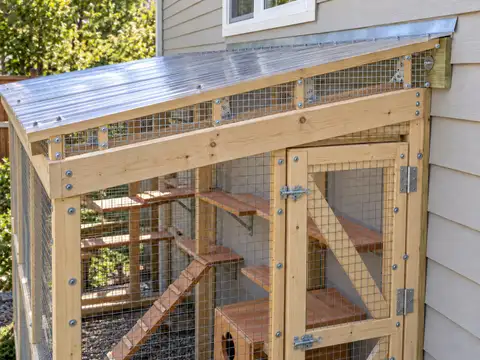
Welded wire is made of straight wires welded at every crossing. It does not stretch or unravel, and it keeps its shape when a cat climbs it. The catio mesh we price is 1 x 2 in at 16 gauge, galvanized, in rolls 3 ft wide and 25 ft long.
Opening size
Animal Welfare Victoria1 recommends galvanized welded mesh for cat enclosures with openings of 50 x 50 mm, about 2 in, at the most. A 1 x 2 in, 1 x 1 in or 1/2 in mesh all fit inside that. Catio Spaces3, a seller of catio plans, suggests a grid no larger than 2 x 4 in; we stay with the stricter number.
Gauge
Wire gauge runs backwards: the lower the number, the thicker the wire. Catio Spaces3 recommends 14 to 16 gauge for catio walls. We price 16 gauge: a YARDGARD 1 x 2 in roll, 3 ft by 25 ft, galvanized, the roll the designer lays its bands out on.
Galvanized, not vinyl coated
Galvanized wire is zinc coated against rust, which matters on a structure that stands outside all year. Catio Spaces3 advises against plastic-coated mesh, and we price galvanized only.
- 1Animal Welfare Victoria (Agriculture Victoria, Australia) Building a cat enclosure attached to an existing structure (2026)
- 2Animal Welfare Victoria (Agriculture Victoria, Australia) Cat-proof fencing (2026)
- 3Catio Spaces (catio plan seller) 8 Catio-Building Mistakes to Avoid (2022)
- 4Catio Spaces (catio plan seller) DIY Catio Materials: How to Pick the Right Cat Enclosure Mesh for Your Catio (2018)
Hardware Cloth: Stronger Choice With Kittens
Hardware cloth is a finer welded mesh, commonly 1/2 x 1/2 in at 19 gauge. A typical roll is 36 in by 10 ft, galvanized after welding (Jackson Wire’s product sheet). It is the better pick when kittens are in the catio, where our gap rule tightens from 1 in to 1/2 in, and where small predators or rodents roam: a 1/2 in opening leaves far less room for a paw or a nose than a 1 x 2 in one.
On our 8x6, hardware cloth totals $1,122.90 against $1,132.11 for welded wire. The difference is small enough that the choice should come down to the cats, not the price.
Chicken Wire: Why We Mark It Red
Chicken wire is light hexagonal wire, twisted rather than welded, usually 19 to 22 gauge according to Catio Spaces3. It is the cheapest mesh on the shelf, and it is the one most first-time catio builders reach for.
It holds a cat in, not a predator out
Animal Welfare Victoria1 itself lists galvanized chicken wire as a cheap alternative for keeping a cat in. The problem is the other direction. Utah State University Extension notes that most predators tear chicken wire and rats chew through thin wire: it keeps birds in, it does not keep predators out. The Association of Shelter Veterinarians5 (2022) asks that enclosed outdoor spaces protect cats from predators. A catio that cannot do that is a cage a raccoon can open.
Plastic netting and screen
Catio Spaces3 advises against plastic-coated and plastic netting. Animal Welfare Victoria1 adds that shade cloth and fly screen need metal mesh behind them. Netting systems sold for catios exist; if you use one, read the maker’s claims about chewing and predators carefully.
Watch out
Chicken wire on an existing catio
If your catio is already in chicken wire, you do not have to tear it down: screw welded wire or hardware cloth over it on the outside of the frame, at least on the lower 3 ft where animals reach and dig.
- 1Animal Welfare Victoria (Agriculture Victoria, Australia) Building a cat enclosure attached to an existing structure (2026)
- 2Animal Welfare Victoria (Agriculture Victoria, Australia) Cat-proof fencing (2026)
- 3Catio Spaces (catio plan seller) 8 Catio-Building Mistakes to Avoid (2022)
- 4Catio Spaces (catio plan seller) DIY Catio Materials: How to Pick the Right Cat Enclosure Mesh for Your Catio (2018)
- 5Association of Shelter Veterinarians The Guidelines for Standards of Care in Animal Shelters, Second Edition, sections 4.2.1 and 4.9 (2022)
How to Fix Catio Mesh So Nothing Gets Through
The best wire fails if it is fixed badly. Humane World for Animals6 asks for no opening a cat can squeeze through, even on top. These are the rules our plans follow.
Mesh on the outside of the frame
The mesh goes on the outside face of the studs, so a pushing cat presses it against the wood rather than off the screws. Every edge of every piece lands on wood: a stud, a plate, or a rail where two bands of mesh meet.
Screws and washers every 6 in
We fix the mesh with a #10 x 1 in stainless pan head screw through a 1/4 x 1-1/4 in stainless fender washer every 6 in along every stud, plate and rail, and at each end of every run. The washer straddles the wire. On the 8x6 that is 591 screws and as many washers. Staples are faster, but the IRC7 (2021, R317.3.1) allows only stainless staples in treated wood, and a washer spreads the hold over several wires where a staple grips one.
No gap at the top or the bottom
Close the mesh to the roof cover: on the side walls, run the top band past the top plate and screw it to the end of every purlin. At the bottom, on the lawn, add a mesh apron. NC State Extension describes burying it at least 6 in or turning it out at least 12 in on the surface; Animal Welfare Victoria1 suggests a buried board or a mesh floor against digging.
Cut ends covered
Cut welded wire leaves sharp ends. Lap them onto the frame and cover them with the next member or a 1x2 strip, so nothing points into the catio. Animal Welfare Victoria1 asks for no sharp edges and nothing a cat can catch its head in.
- 1Animal Welfare Victoria (Agriculture Victoria, Australia) Building a cat enclosure attached to an existing structure (2026)
- 2Animal Welfare Victoria (Agriculture Victoria, Australia) Cat-proof fencing (2026)
- 6Humane World for Animals (formerly the Humane Society of the United States) Catios: Safe Outdoor Enclosures for Happy, Healthy Cats (2026)
- 7International Code Council Chapter 3 Building Planning (2021)
Mesh on the Roof
A catio needs a top, as Best Friends8 Animal Society points out: cats climb, and a wall without a roof is a ladder. The roof can be solid, mesh, or half and half, and the mesh choice changes with it.
When a mesh roof works
A mesh roof lets in full sun and rain and costs no panels. On the 8x6 it brings the catio to $1,117.88, against $1,132.11 with polycarbonate, because the roof mesh needs its own purlins at every band joint and more screws. In a climate with no snow and with shade from shelves and a hiding box, it is a fine roof.
Why we do not verify mesh roofs for snow
We looked for load data from the makers of welded wire and hardware cloth and found none. Without it there is no honest way to say how much snow a mesh roof holds before it sags or tears off its screws. So with any snow load the designer marks a mesh roof “not verified”, the solid roof becomes the default, and above 30 psf a mesh roof is not offered at all. A half roof, panels over the back and mesh over the front, keeps some sun and puts the snow on the panels.
- 8Best Friends Animal Society Outdoor Catio Ideas: What You Need to Know (2026)
Mesh on the Floor, and Under It
Floors are not mesh
Cats should not live on wire. ASPCApro’s9 checklist for shelter enclosures calls wire or slatted floors unacceptable. Our catios stand on a patio, a deck or the ground, and the floor is whatever is already there.
The apron against digging
On the lawn, the mesh goes on under the walls instead: an apron of the same welded wire, either laid 12 in out on the surface and pinned every 12 in, or buried 12 in and turned 6 in outward. Cats rarely dig out, as Animal Welfare Victoria1 notes, but foxes, dogs and raccoons dig in.
- 1Animal Welfare Victoria (Agriculture Victoria, Australia) Building a cat enclosure attached to an existing structure (2026)
- 2Animal Welfare Victoria (Agriculture Victoria, Australia) Cat-proof fencing (2026)
- 9ASPCApro Primary Enclosure Checklist (2024)
Buying the Mesh: Rolls, Widths and Lengths
Roll sizes
Welded wire and hardware cloth are sold by the roll, and the roll sizes decide how much you waste. On Oct 8, 2026 the stores we read listed 1/2 in hardware cloth 2 ft wide in 10, 25, 50 and 100 ft rolls and 3 or 4 ft wide in 10, 50 and 100 ft, chicken wire 2 to 4 ft wide, and 1 x 2 in 16 gauge welded wire 3 ft wide in 25 ft rolls.
Bands that match the rolls
Our designer lays the mesh on each wall in horizontal bands as wide as the roll, with a rail in the frame at every joint, and picks the roll width that costs least for the design. A longer roll is often cheaper per foot; where the store had one, the designer’s materials list says so.
Tools for cutting
Cut welded wire with aviation snips along a line of crossings, so no long spikes are left, and wear gloves: fresh cut ends are sharp. A pair of lineman’s pliers helps fold the ends over a frame member.
Is 19 Gauge Strong Enough?
Searchers ask whether 19 gauge wire is strong enough for a poultry pen, which is the same question for a catio. Hardware cloth is commonly sold at 19 gauge in 1/2 in openings, and it is the finer, stronger-than-chicken-wire choice we describe above. We found no maker’s load or tear data for it, so we cannot give a pull strength. What we can say is how the choices differ for a catio: the wire is there to hold a cat in and keep predators out, so look at the opening first (2 in or less), then at whether the crossings are welded rather than twisted, then at the gauge. A heavier gauge in 1 x 2 in welded wire is the stronger of the two for large predators; 1/2 in hardware cloth stops smaller animals reaching through. On a catio where you worry about both, the two can be combined, with hardware cloth over the lower band.
Which Wire for Which Catio
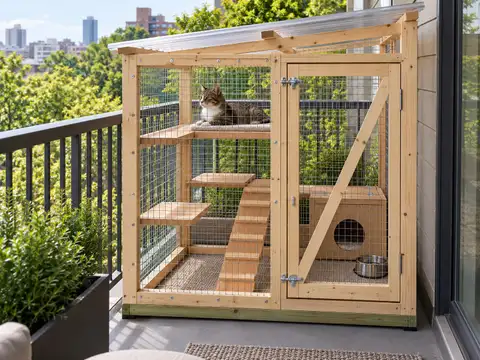
- Window box catio on an upper floor: welded wire or hardware cloth both work. Pick the lighter hardware cloth if you worry about the weight on the wall.
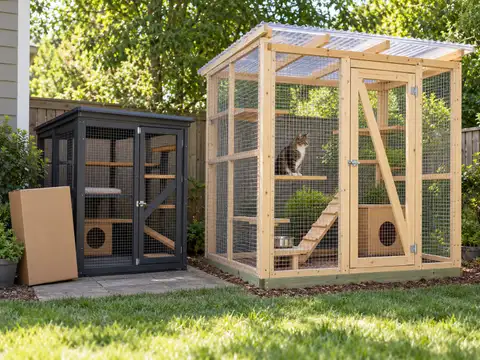
- Walk-in on the lawn with raccoons or foxes about: 1 x 2 in welded wire on all walls plus the dig-proof apron, with hardware cloth over the lowest band if small animals are a concern.
- Kitten or small-cat catio: 1/2 in hardware cloth, because kittens fit through gaps an adult cat does not.
- Warm climate, covered patio: a mesh roof is fine, as above.
- Any climate with snow: a solid or half roof, and the mesh on the walls only.
A Quick Fix Checklist Before the First Cat
- Run a hand along every cut edge: nothing sharp should point into the catio.
- Pull on each screw and washer: the mesh should not move.
- Look for any opening wider than 2 in at corners, door frames and where the mesh meets the house.
- Shake the door and check the latch from the cat’s side.
- Walk the catio at dusk: if you can see light through a gap you did not mean to leave, so can a predator.
Looking After the Mesh
Galvanized mesh lasts years outdoors, but the fixings are the weak point. Once a season, walk around the catio and press every seam: a screw that has backed out, a washer that has slipped off the wire, or a cut end that has sprung loose are all easy fixes before a cat finds them. After a heavy snow, check the roof mesh for sag even if the frame looks fine.
How Much Mesh a Catio Needs
Our designer lays the mesh out in bands that match the roll widths and buys whole rolls. The 8x6 freestanding catio takes $251.96 of welded wire with a solid roof. A mesh roof instead of panels needs more rolls: that design comes to $1,117.88 in all. A catio on the lawn adds the apron, $160.74 on the same design.
The catio cost calculator shows the rolls for any size and mesh, and the guide to building a catio puts the mesh step in context. Comparing to a kit? The catio kit vs DIY guide lists what to check in a kit’s mesh before you buy.
Sources
Every number in this guide that does not come from our own catio designer was checked against these 12 documents, numbered in the order the text first cites them and read between Oct 8, 2026 and Oct 13, 2026. 10 are welfare bodies, codes, makers and stores; 2 are secondary sources (catio sellers' guides), marked, used only where no welfare body, code or maker gives a number.
- 1Animal Welfare Victoria (Agriculture Victoria, Australia)Building a cat enclosure attached to an existing structure (2026)
- 2Animal Welfare Victoria (Agriculture Victoria, Australia)Cat-proof fencing (2026)
- 3Catio Spaces (catio plan seller)Secondary source8 Catio-Building Mistakes to Avoid (2022)
- 4Catio Spaces (catio plan seller)Secondary sourceDIY Catio Materials: How to Pick the Right Cat Enclosure Mesh for Your Catio (2018)
- 5Association of Shelter VeterinariansThe Guidelines for Standards of Care in Animal Shelters, Second Edition, sections 4.2.1 and 4.9 (2022)
- 6Humane World for Animals (formerly the Humane Society of the United States)Catios: Safe Outdoor Enclosures for Happy, Healthy Cats (2026)
- 7International Code CouncilChapter 3 Building Planning (2021)
- 8Best Friends Animal SocietyOutdoor Catio Ideas: What You Need to Know (2026)
- 9ASPCAproPrimary Enclosure Checklist (2024)
- 10Jackson Wire (mesh maker), product sheet via a distributorJackson Wire 11 03 16 13 Hardware Cloth, 10 ft L, 36 in W, 19 Gauge, 1/2 x 1/2 in Mesh, Galvanized (2026)
- 11NC State ExtensionKeeping Garden Chickens in North Carolina (2008)
- 12Utah State University ExtensionRodents and Backyard Chickens (2018)