The short answer
Three options: enclose the balcony with cat-proof mesh or netting (renter friendly if it needs no drilling), stand a small catio on the balcony floor, or hang a window box on a lower-floor window. Get written permission first, keep lilies off the balcony, and never leave the cat out unsupervised.
A balcony catio turns an apartment balcony into a safe outdoor space for a cat. Unlike a backyard catio, it is shaped by things you do not control: the railing, the floor, the walls of the building, and above all the landlord or the building’s rules. This guide covers the three ways to build a balcony catio, what each involves, and what our catio designer can and cannot draw for you.
Three Ways to Build a Balcony Catio
1. Enclose the whole balcony
The most common apartment catio closes the balcony itself: mesh or netting on every open side and across the top, so the balcony becomes the catio. It gives the cat the most space and keeps the balcony usable for you. It is also the option that most often needs permission, because the mesh is fixed to the building.
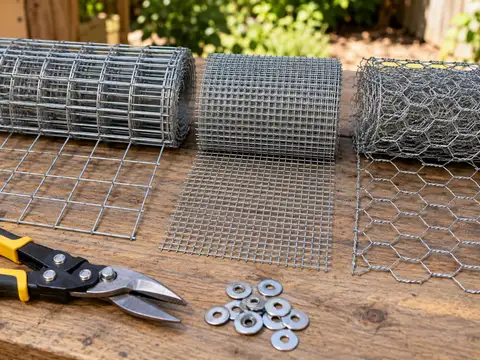
Mesh. Galvanized welded wire is what Animal Welfare Victoria1 recommends for cat enclosures, with openings of 2 in (50 mm) at most. It is stiff, it lasts, and it is the strongest choice, but it needs a frame or fixings.
Cat net. Netting systems sold for balconies are lighter and easier to fit, often on pressure-mounted poles. Animal Welfare Victoria’s1 guidance is that light netting, shade cloth or fly screen needs metal mesh behind it where safety matters; on a high balcony, it does. Read the maker’s claims about chewing and loads carefully.
2. A small catio on the balcony floor
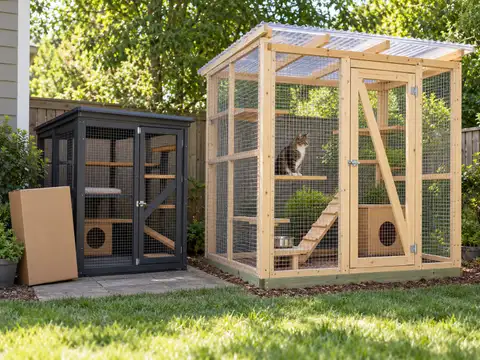
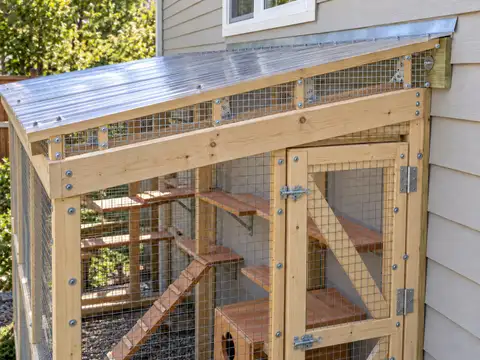
If you cannot fix anything to the building, a small catio can stand on the balcony on its own. Our designer does not draw a balcony enclosure, but its smallest designs fit many balconies: a 6x4 lean-to against the wall costs $903.75 in materials and a 6x4 freestanding catio $943.47. Two caveats: our plans screw the bottom plates down to the deck or patio, which a lease may not allow, and the lean-to’s ledger is lag-screwed into the house framing, which on an apartment wall is the building’s call.
3. A window box on a lower floor
On a ground or low floor, a window box catio hangs on the wall under a window and costs $433.05 in materials. It needs a 2x8 ledger lag-screwed into the wall framing, so it is a homeowner’s or landlord’s project, not a renter’s.
- 1Animal Welfare Victoria (Agriculture Victoria, Australia) Building a cat enclosure attached to an existing structure (2026)
- 2Animal Welfare Victoria (Agriculture Victoria, Australia) Cat-proof fencing (2026)
Renter-Friendly Balcony Catios
An apartment catio for renters has one rule above the rest: it must come off without damage when you move out.
Ask first, in writing
Humane World for Animals3 puts it simply: if you rent, talk to your landlord before you build; some catios need approval from the city or the HOA. In Canada, the condo board or strata council plays the same role for a balcony. Written approval saves a dispute about the deposit later.
No-drill fixings
Pressure-mounted poles between the balcony floor and the ceiling above, railing clamps, and freestanding frames hold mesh or netting without a single hole. They suit covered balconies; an open balcony with no ceiling needs a freestanding frame or the building’s approval to fix one.
Portable catios
Some store kits and net catios fold down and move with you. The catio kit vs DIY guide lists the ones we saw for sale with their prices; on a balcony, check the footprint and whether it can be weighted rather than staked.
- 3Humane World for Animals (formerly the Humane Society of the United States) Catios: Safe Outdoor Enclosures for Happy, Healthy Cats (2026)
Make the Balcony Safe for a Cat
Close the top
A railing is not a barrier to a cat. Animal Welfare Victoria1 notes that some cats jump 1.8 m (about 6 ft) in a single leap, and that open-top fencing needs to be at least 2 m tall with angled mesh at the top. On a balcony the simple answer is mesh or net across the top as well.
No gaps
Humane World for Animals3 asks for no openings a cat can squeeze through, even at the top. Our designer uses 1 in as the largest gap anywhere, 1/2 in with kittens. Check where the mesh meets the wall, the railing, the floor and the ceiling.
Shade, water and a way back in
Balconies get hot. Animal Welfare Victoria1 asks for shelter from sun, wind and rain with access to sun, and the ASPCA4 advises fresh water and shade in hot weather and bringing pets in when it is very hot. A balcony catio should always have the door to the apartment open behind it.
Watch the first visits
Cat Protection NSW advises supervising cats in a new enclosure, because some find a way out the builder did not see. On a balcony, a missed gap is a fall.
- 1Animal Welfare Victoria (Agriculture Victoria, Australia) Building a cat enclosure attached to an existing structure (2026)
- 2Animal Welfare Victoria (Agriculture Victoria, Australia) Cat-proof fencing (2026)
- 3Humane World for Animals (formerly the Humane Society of the United States) Catios: Safe Outdoor Enclosures for Happy, Healthy Cats (2026)
- 4ASPCA Hot Weather Safety Tips (2026)
- 5ASPCA Toxic and Non-Toxic Plant List: Cats (2026)
Plants on a Cat Balcony
A balcony full of pots is part of the appeal, and part of the risk. The ASPCA’s4 list of toxic and non-toxic plants for cats is the reference: it lists Boston fern, spider plant, areca palm and basil among the non-toxic ones, and catnip, lavender and mint among the toxic ones. True lilies and daylilies are the plants to keep out entirely: the FDA warns that the whole plant is toxic to cats and can cause kidney failure.
Size: How Much Balcony a Cat Needs
Animal Welfare Victoria1 asks for about 2 square meters (21.5 sq ft) of floor per cat in an enclosure, with time indoors as well. A 6 x 4 ft balcony is 24 sq ft: enough for one cat by that measure. Height and shelves matter as much as floor; the catio size calculator does the arithmetic for your balcony and your cats.
- 1Animal Welfare Victoria (Agriculture Victoria, Australia) Building a cat enclosure attached to an existing structure (2026)
- 2Animal Welfare Victoria (Agriculture Victoria, Australia) Cat-proof fencing (2026)
Measure the Balcony Before You Buy Anything
Whatever the option, start with a tape measure and a sketch:
- Floor: width and depth, wall to railing, and where the door swings.
- Height: floor to ceiling if the balcony is covered, or to the top of the wall if it is not.
- Openings: the railing height, the gaps between balusters, and any gap at the floor or under the ceiling.
- Fixing points: what the walls, the ceiling and the railing are made of, and what the lease or the building’s rules say about fixing to them.
- Drainage: where the water goes when it rains, so nothing you add blocks the drain.
The width and depth tell you how many cats the balcony suits at about 21.5 sq ft each; the height and the openings tell you how much mesh or netting you need and where.
What to Put Inside a Balcony Catio
A balcony catio is small, so it pays to use the walls. Animal Welfare Victoria1 asks for at least two platforms at different heights and a scratching post in a cat enclosure; the AAFP and ISFM6 guidelines value a high place to watch from, and the shelter vets (ASV 2022) a place for every cat to hide. In practice:
- Shelves: one or two cedar shelves on the wall at different heights, close enough for a cat to step between them.
- A hiding box: a covered bed or a box the cat can retreat into.
- Water: fresh, in the shade, refilled every time the cat goes out.
- Litter: with the apartment door open behind the catio, the litter box can stay indoors, as Humane World for Animals notes.
- Something to look at: a perch at the railing height, behind the mesh, is the reason most cats want to be out there.
- 1Animal Welfare Victoria (Agriculture Victoria, Australia) Building a cat enclosure attached to an existing structure (2026)
- 2Animal Welfare Victoria (Agriculture Victoria, Australia) Cat-proof fencing (2026)
- 3Humane World for Animals (formerly the Humane Society of the United States) Catios: Safe Outdoor Enclosures for Happy, Healthy Cats (2026)
- 6AAFP and ISFM, Journal of Feline Medicine and Surgery AAFP and ISFM Feline Environmental Needs Guidelines (2013)
Cat Netting or Welded Wire on a Balcony?
Related searches ask for cat netting for a balcony, and for balcony enclosures by name. Both exist as products, and we have not tested any. What we can say is how to judge them. Netting is light and easy to fix with no drilling, which suits a renter. Welded wire is stronger against a cat that climbs and chews, and it is what our designs use elsewhere, but it needs a frame to be fixed to. On a balcony, whichever you choose has to close the top as well as the sides, leave no opening wider than 2 in, and be fixed so a cat cannot work it loose. Before buying, ask the seller for the opening size and the fixing method, and if neither is stated, treat the enclosure as unverified.
A First-Week Plan
A new balcony catio is a change of scenery, and some cats are slow to trust it. A gentle schedule helps, and it is editorial advice, not a measured result:
- Day 1 to 2: open the door and let the cat look. Do not carry it out. Put a familiar blanket and a bowl of water inside.
- Day 3 to 4: short supervised visits, five to ten minutes, with you sitting in the doorway.
- Day 5 to 7: longer visits as the cat chooses, with shade, a perch and a hiding box.
- After that, check the mesh and the fixings each week for the first month, since cats find the gap an installer did not see.
Keeping a Cat in an Apartment
People also ask how to keep a cat in an apartment. A balcony catio does not replace play and attention indoors, but it adds the one thing a window cannot: air, scents and birds a cat can watch from a safe place. We cannot tell you how much outdoor time your cat needs, and the welfare guides we cite ask for supervision rather than a number of hours.
Weather on a Balcony
Sun and heat
A balcony in full afternoon sun can get hot in summer, and a concrete floor holds the heat into the evening. The ASPCA4 notes that flat-faced breeds such as Persians are more sensitive to heat. Keep part of the balcony shaded, put the water in that shade, and bring the cat in on hot afternoons.
Wind
High balconies are windy. Anything light on a balcony, a net catio, a fabric cover, a plant pot, needs to be secured so it does not move or fly off. That is one more reason to check how a netting system is held.
Cold
In cold winters, Best Friends7 advises access to a heated room and never leaving a cat in an isolated enclosure in severe cold. With the apartment door open behind it, a balcony catio meets that by design; do not shut the cat out on it.
- 4ASPCA Hot Weather Safety Tips (2026)
- 5ASPCA Toxic and Non-Toxic Plant List: Cats (2026)
- 7Best Friends Animal Society Outdoor Catio Ideas: What You Need to Know (2026)
What It Costs
The cost of a balcony catio depends on the option. Netting systems and portable catios are sold as products, and the catio kit vs DIY guide lists the prices we saw. For a built catio, our designer prices the materials of any design: the window box at $433.05, the 6x4 lean-to at $903.75, before tax. The catio cost calculator shows every line, and you can type in your own store’s prices.
When a Balcony Is Not the Answer
Some balconies cannot be made safe for a cat at a reasonable cost: no permission to fix anything, an open top with nothing to fix mesh to, or a building that does not allow it at all. In that case, a window box on a ground-floor window, a friend’s or family member’s yard, or supervised time on a harness are the alternatives. A cat that never goes out is better than a cat on an open balcony.
Next Steps
If you have a yard or a ground-floor wall, the catio attached to the house guide covers lean-tos and window boxes in detail, and how to build a catio covers the full build. To try sizes and see prices, open the catio designer.
Sources
Every number in this guide that does not come from our own catio designer was checked against these 11 documents, numbered in the order the text first cites them and read between Oct 10, 2026 and Oct 13, 2026. 11 are welfare bodies, codes, makers and stores.
- 1Animal Welfare Victoria (Agriculture Victoria, Australia)Building a cat enclosure attached to an existing structure (2026)
- 2Animal Welfare Victoria (Agriculture Victoria, Australia)Cat-proof fencing (2026)
- 3Humane World for Animals (formerly the Humane Society of the United States)Catios: Safe Outdoor Enclosures for Happy, Healthy Cats (2026)
- 4ASPCAHot Weather Safety Tips (2026)
- 5ASPCAToxic and Non-Toxic Plant List: Cats (2026)
- 6AAFP and ISFM, Journal of Feline Medicine and SurgeryAAFP and ISFM Feline Environmental Needs Guidelines (2013)
- 7Best Friends Animal SocietyOutdoor Catio Ideas: What You Need to Know (2026)
- 8Association of Shelter VeterinariansThe Guidelines for Standards of Care in Animal Shelters, Second Edition, sections 4.2.1 and 4.9 (2022)
- 9Cat Protection Society of NSW (Australia)Factsheet: Cat-proof fencing and enclosures (2023)
- 10International Code CouncilChapter 1 Scope and Administration, R105.2 Work exempt from permit (2021)
- 11US Food and Drug AdministrationLovely Lilies and Curious Cats: A Dangerous Combination (2021)